Iceland is not just a land of glaciers and geysers, but a developed country with a high standard of living, where the crime rate is so low that police officers do not carry firearms. The mayor of the capital can quite literally be a comedian, which reflects the absence of prejudice among the local population. Obtaining Icelandic citizenship means becoming part of one of the most prosperous societies in the world, with unrestricted access to advanced healthcare, free education, and visa-free travel to 168 countries.
An Icelandic passport opens up unique opportunities to live in an environmentally clean setting, with direct access to the EU labor market through the EEA Agreement, while also ensuring a high level of social stability. However, to obtain this document, you will need not only knowledge of the language, but also lawful residence in the country for the previous seven years, as well as no tax debts during that period. Below, we will examine the step-by-step naturalization process (acquiring citizenship through residence) and the specifics of Icelandic immigration law.
2026 Realities: Laws and Trends
In 2026, Iceland’s migration policy continues to balance between a growing shortage of skilled professionals and the desire to preserve its unique cultural identity. Following extensive parliamentary discussions, updated protocols have come into force, making residence and citizenship procedures more transparent while imposing stricter requirements regarding the availability of digital records in state databases and the applicant’s social responsibility.
Whereas previously basic knowledge of the Icelandic language could be confirmed by a formal certificate, the current focus has shifted toward its practical use. Now, a course completion certificate must be supplemented by proof of active participation in community life (for example, volunteering or membership in professional associations).
The Directorate of Immigration has fully synchronized its databases with the tax authority (Skatturinn). Any outstanding debt to the state, even a minor fine, automatically suspends the processing of a citizenship application until it is fully settled. This year, the government has introduced preferential waiting periods for specialists in renewable energy and climate technologies. For such applicants, the required residence period may be reduced on a case-by-case basis.
A key trend of the year is the crackdown on sham marriages and nominal employment. Verification procedures have become more thorough, including confirmation of actual residence at the registered address through utility data.
Iceland withdrew its EU membership application in 2015 but has recently reopened discussions about potential accession. If your goal is to obtain an EU passport, you could acquire Icelandic citizenship and wait for possible membership. However, a faster way to achieve the same result may be to use one of the simplified EU citizenship programs. In such cases, the process can take just over a year with the support of an immigration lawyer.

Individual selection of immigration program
Get more information about the peculiarities of immigration to the EU at a free consultation

Extended Opportunities: What an Icelandic Passport Offers
An Icelandic passport is not only one of the most powerful in the world it is also a gateway to a unique socio-economic ecosystem. In addition to visa-free travel to over 160 countries (including the United States, Canada, and the United Kingdom), and the right to live and work in any EU/EEA country, Icelandic citizenship provides a number of advantages that are difficult to find elsewhere.
Iceland is an active member of the Arctic Council. Its citizens have priority access to specialized grants for research, business startups, and cultural projects related to the Arctic. This opens doors to a niche sector of high technology and eco-innovation.
While residents can study at local universities, only Icelandic citizens are eligible for state-backed student loans and grants (Lánasjóður íslenskra námsmanna — LÍN) to study at top universities worldwide. In effect, the government supports its citizens in pursuing education at institutions like Harvard or Oxford, provided they return to Iceland afterward.
Amid the global energy crisis, Iceland provides its citizens with virtually free heating and hot water through geothermal energy sources. Citizenship guarantees long-term access to these resources and participation in their management through state cooperatives.
Iceland also enforces the Equal Pay Certification law. Citizens benefit from strong protection by trade unions, which are among the most influential in the world (covering over 90% of the population). This ensures that income levels meet high standards regardless of gender or origin.
Since 2003, Iceland has allowed dual citizenship. After naturalization, you can retain your original passport while gaining voting rights in parliamentary elections and the ability to directly influence policy in what is often described as one of the most peaceful countries in the world.
Ways to Become an Icelandic Citizen
The path to obtaining a second passport in Iceland largely depends on your current status and history of residence in the country. Unlike many EU states, Iceland maintains a conservative approach to residency requirements but offers unique pathways for those who have genuinely integrated into society.
General Naturalization
This is the standard route to citizenship for most foreign nationals who have moved to Iceland for work, study, or business immigration. It is suitable for expatriates who have lived in the country legally for an extended period. The standard requirement is 7 years of continuous residence.
The Directorate of Immigration counts only those years during which the applicant has not spent more than 90 days abroad per year. Exceeding this limit is allowed only in exceptional cases, for example, studying at a foreign university or due to serious health conditions affecting the applicant or their close relatives. Time spent studying at a university does not count toward the residency period (unless the individual transitions directly to a work visa after graduation).
Key requirements for applicants:
- no criminal record (including offenses such as driving under the influence);
- proof of a monthly income of at least ISK 247,572 (approximately €1,722) per person;
- successful completion of an Icelandic language exam (level B1/B2 depending on the applicant category).
Citizenship by Decision of the Althing (Special Parliamentary Grant)
A unique pathway specific to Iceland allows citizenship to be granted not by the Directorate of Immigration, but through a vote in parliament (the Althing). This option is suitable for individuals who do not meet standard criteria (for example, the 7-year residence requirement) but have made an outstanding contribution to Icelandic society or have exceptional humanitarian grounds for immigration.
Twice a year, parliament reviews a special legislative proposal that includes the names of specific individuals. If your name is included and the law is approved, you become a citizen immediately. This pathway is often used for prominent athletes, cultural figures, or in high-profile humanitarian cases.
Citizenship for Citizens of Nordic Council Countries
Iceland maintains special relations with Denmark, Norway, Sweden, and Finland. As a result, applicants from Nordic countries can obtain citizenship with a reduced residency requirement, after just 3 years of residence. The process follows a simplified procedure without lengthy background checks. The main conditions include being of legal age, lawful residence in Iceland for at least 3 years, and no criminal record. Applicants who do not fully meet these criteria may still qualify for Icelandic citizenship after 4 years of residence.
Refugee or Stateless Status
For foreign nationals who have been granted official refugee status in Iceland, the required period of residence for citizenship is reduced to 5 years. Language requirements remain in place, although exemptions may be granted for medical reasons.
Restoration of Icelandic Citizenship
Restoration of citizenship is a simplified procedure for individuals who previously held an Icelandic passport. Before the reform of July 1, 2003, Icelanders automatically lost their citizenship upon acquiring another nationality, as dual citizenship was not permitted. Today, such individuals can restore their Icelandic citizenship while retaining their foreign one. To do so, it must be proven that the applicant originally held Icelandic citizenship by birth or naturalization before it was lost.
If a child is born abroad to Icelandic parents and has never lived in Iceland, they may automatically lose citizenship upon reaching the age of 22. If the deadline to apply for retention of citizenship before age 22 was missed, it is possible to submit a request for restoration. Typically, applicants must demonstrate strong ties to Iceland, such as previous residence in the country or frequent visits.
Unlike general naturalization, restoration usually requires only 1 year of residence in Iceland immediately prior to submitting the application. In some cases (for example, if the loss of citizenship was unfair or due to technical reasons), the Ministry of Justice may restore citizenship even if the applicant resides abroad, provided they have “special merits” or strong ties to the Icelandic community.
It is also possible to obtain second citizenship without residency requirements in certain EU countries. Participants in simplified programs can receive a passport within approximately one year, gaining full rights within the European Union without long waiting periods.
Icelandic Citizenship for Children and Family Aspects
The Icelandic Citizenship Act is based on the principle of jus sanguinis (right of blood). This means that the status of the parents is decisive, rather than the place of birth. If at least one parent is an Icelandic citizen, the child automatically acquires citizenship, regardless of whether they are born in Iceland or abroad. If the Icelandic father was not married to the foreign mother at the time of the child’s birth, a paternity recognition procedure may be required for the child to obtain citizenship automatically.
If both parents are foreign nationals, a child born in Iceland acquires their citizenship and immigration status (temporary or permanent residence). If the parents later naturalize, a minor child living with them obtains citizenship simultaneously with the main applicant.
Marriage can simplify and accelerate the process, allowing applicants to reduce the standard 7-year residency requirement. It is possible to obtain Icelandic citizenship after 4 years (instead of 7) if, at the time of application, the marriage has lasted at least 4 years, the applicant resides in Iceland, and the spouse has held Icelandic citizenship for at least 5 years.
Iceland is one of the few countries where registered cohabitation is treated similarly to marriage for immigration purposes. A partnership can be officially recorded in the National Registry, making it easier to prove the existence and duration of the relationship. In such cases, a 5-year residence requirement applies for citizenship.
Even when married to an Icelandic citizen, applicants must meet all standard requirements. Family status does not exempt them from passing the Icelandic language test. Financial checks apply to both spouses, the family must not have relied on social benefits for the past 3 years. The Directorate of Immigration carefully investigates potential sham marriages through detailed interviews and verification of shared addresses.
A foreign child adopted by Icelandic citizens automatically acquires citizenship if they are under 12 years old at the time the adoption is finalized. If the child is older than 12, a simplified naturalization application must be submitted.
Step-by-Step Guide: How to Obtain Icelandic Citizenship
The process of obtaining Icelandic citizenship is strictly regulated and consists of several stages:
- Obtaining a residence permit.
Foreign nationals planning to naturalize must obtain a residence permit before entering the country. An exception applies to spouses of citizens or permanent residents who are already in Iceland, for example, on a visa. Applications must be submitted to the Directorate of Immigration by mail or electronically. Processing takes from 3 months. As of 2026, fees range from ISK 40,000 to 110,000 (€279–766). The initial residence permit is usually issued for up to one year. - Renewal of the residence permit.
At this stage, it is important not to change the basis of your permit (e.g., not leaving your job if it is work-based), to pay taxes, and to remain in the country for at least 9 months per year. Renewal is done online via the official website of the Directorate of Immigration. Documents must be submitted no later than 2 months before the permit expires. Applications are processed within up to 90 days. The cost is similar to the initial application fee. If approved, the permit is extended for another 1–2 years depending on the basis. - Applying for Permanent Residence (PR).
This is an “indefinite” residence status, which requires at least 4 years of residence in Iceland, a clean legal record, and completion of an Icelandic language course (minimum 150 hours). The administrative fee is approximately €418 for adults and €209 for minors. Processing times have increased and average around 9 months. Applications are submitted online. Although the status is permanent, the physical residence card must be renewed every 5 years (fee: about €56). - Passing the language exam.
This is mandatory for all adult applicants. Exams are held twice a year (usually in May and November). Applicants must demonstrate listening, reading, and speaking skills. Registration must be done several months in advance due to limited availability. Exams are conducted in accredited centers in Reykjavík, Akureyri, Egilsstaðir, and Ísafjörður. The fee is about €279, and results are processed within 6 weeks. A certificate is issued upon passing, which is required for citizenship. - Applying for Icelandic citizenship.
After fulfilling the residency requirement (typically 7 years), you may apply for citizenship. It is essential that you have no tax debts and have not received social assistance in the past 3 years. The application is submitted online through the Directorate of Immigration portal and costs about €418. Once approved, a citizenship certificate is sent by mail, which allows you to apply for an Icelandic passport. There is no online system to track application status. - Obtaining the passport.
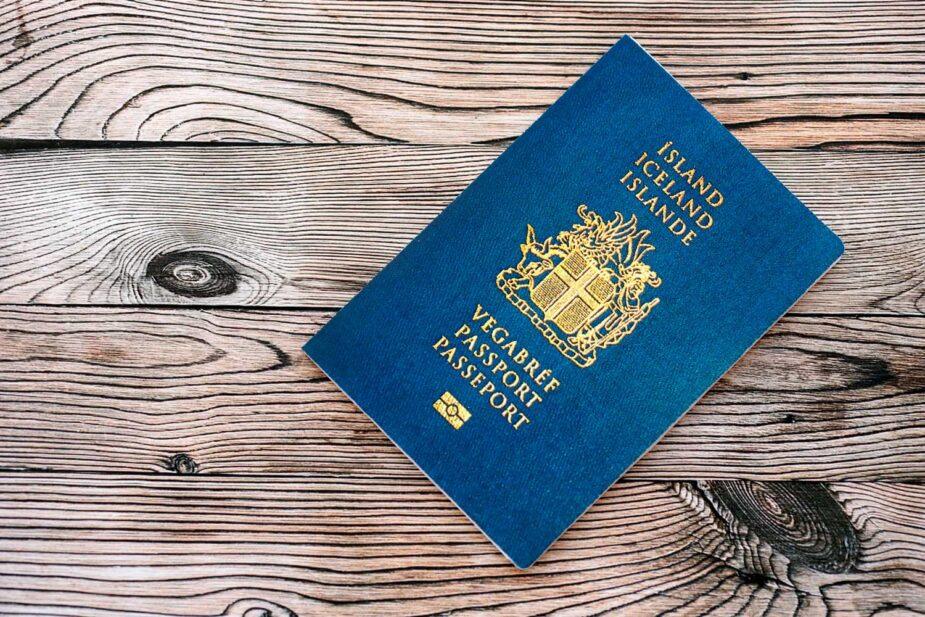
The modern Icelandic passport is a booklet with a dark blue cover. In the center, the Icelandic coat of arms is embossed in gold, depicting the country’s four guardian spirits: a bull, an eagle, a dragon, and a giant. Below the emblem, the word “ÍSLAND” is inscribed in large letters. The inner pages feature unique illustrations of Icelandic nature and cultural symbols, which become visible or change color under ultraviolet light. The Icelandic national ID is a biometric plastic card with the holder’s photo and personal data, used as an identity document within the country.
A passport application can be submitted online via the government services portal. Processing takes up to 4 days from the date of application. The state fee is approximately €132 for adults, while children, persons with disabilities, and pensioners pay around €49.

Submit an application form and we'll get back to you!
Requirements for Obtaining Icelandic Citizenship
To qualify for an Icelandic passport, an applicant must meet several criteria. The primary requirement is continuous residence in Iceland for a specified period (4–7 years, depending on individual circumstances) prior to submitting the application. Continuous residence means that you must not have been outside the country for more than 90 days in total during any year of the qualifying period.
In addition to the residency requirement, applicants must demonstrate integration into society, law-abiding behavior, and financial independence. You must prove that you can support yourself and your family and confirm that you have not received municipal financial assistance during the last 3 years. The minimum required income must meet established thresholds (ISK 247,572, approximately €1,722). A certificate from the tax authority must confirm that you have no outstanding debts to the state.
The law also requires the absence of criminal convictions and successful completion of an Icelandic language exam (unless you are over 65 or have medical exemptions).
Required Documents for Citizenship Application
To successfully apply, several document packages must be prepared: a general set, documents confirming the grounds for application, and additional documents for children.
General documents (for all applicants):
- a completed standard application form;
- a color copy of all completed pages of your passport;
- legally certified original criminal record certificates from each country where you have lived since the age of 15;
- a certificate from the tax authority confirming no outstanding debts.
As proof of the grounds for the application, you should provide a marriage certificate, an extract from the population register confirming cohabitation, or a letter from your employer verifying current employment along with an employment contract. Additional documents for children under 18:
- birth certificate;
- written consent from the second parent for the child to obtain Icelandic citizenship (if only one parent is applying);
- the child’s written consent if they are over 12 years old.
All foreign documents must be apostilled (or legalized) and translated into English or any Scandinavian language by translators authorized in Iceland. Translations made abroad are also accepted if notarized.
Cost of Obtaining Citizenship
It is not possible to “buy” Icelandic citizenship through investment. The country does not offer a “Golden Passport” program. The only way to obtain citizenship is through legal naturalization, which involves paying various administrative fees. The cost of each stage as of 2026 is shown below:
| Expense Category | Cost (€) |
| Residence permit (initial) | 279–766 |
| Residence permit renewal | 279–766 |
| Permanent residence (adult/minor) | 418 / 209 |
| Language exam | 279 |
| Citizenship application | 418 |
| Passport issuance (adult) | 132 |
Additional costs for preparing documents depend on the applicant’s country of origin. On average, certified translations cost from €15 per document, and obtaining an apostille starts from €20. Overall, the minimum total cost of obtaining Icelandic citizenship is approximately €2,000.
There is no official “fast-track” option for processing citizenship applications in Iceland. All cases are reviewed in order of submission. The only exceptions are humanitarian cases or decisions made by the Althing, but these are not commercial services.
Dual Citizenship in Iceland
Before 2003, Icelanders who acquired another nationality automatically lost their Icelandic citizenship, and foreign nationals applying for naturalization were required to renounce their original citizenship. These rules have since been abolished, Iceland now officially allows dual citizenship. You can retain your original passport when obtaining Icelandic citizenship and may also acquire additional citizenships afterward.
However, while Iceland permits multiple citizenships, your home country may have different laws. If your country prohibits dual citizenship, you may automatically lose your original nationality upon acquiring Icelandic citizenship. It is essential to review your country’s legislation before applying.
Holding two passports comes with certain obligations, so it is important to use them correctly. When entering Iceland or any Schengen country, you must present your Icelandic passport. As an Icelandic citizen, you have an unconditional right of entry that cannot be restricted by visa regulations.
When traveling to your country of original citizenship, most states require their citizens to enter using their national passport. During flight check-in, present the passport that allows entry into your destination country (to avoid visa-related issues with the airline). At border control, always present the passport of the country whose border you are crossing.
Learn more about the chances for fast, easy and guaranteed obtainment of second citizenship
Submit an application form and we'll get back to you!
Debunking Myths and Common Mistakes
Iceland is a small country whose immigration laws are not widely understood, which has led to many misconceptions online. For example, there is a persistent myth that “the government pays foreigners €5,000 per month to marry Icelandic women.” This is one of the most widespread fake claims circulating on social media.
In reality, the government has never paid for marriages. On the contrary, obtaining citizenship through marriage has become more demanding, you must now live in the country for 3–4 years, prove the authenticity of the relationship, and have a stable income. Iceland does not rely on artificial population growth through such measures.
Another common myth is that “you can obtain citizenship simply by starting a business or buying property.” In fact, Iceland does not offer “golden visas.” Purchasing real estate does not grant the right to a residence permit. Starting a company may qualify you for a business residence permit, but you must actively work in the company, pay yourself a market-level salary, and live in Iceland for 7 years before becoming eligible to apply for citizenship.
Finally, there is the belief that “a child born in Iceland automatically becomes a citizen.” Iceland does not apply jus soli (right of the soil) for foreigners. For a child to receive Icelandic citizenship, at least one parent must be a citizen. If both parents are expatriates, the child simply receives a residence permit.
According to feedback from immigrants who have obtained citizenship, applications can be rejected even for minor violations. For instance, one applicant from the United States lived in Reykjavík for 7 years and applied for citizenship, confident of success, but was denied. It turned out that he had once spent 94 days abroad (exceeding the 90-day limit). The Directorate of Immigration ruled that the “continuity of residence” had been broken. As a result, that year was excluded, and the applicant had to wait another 12 months before reapplying.
Other common reasons for rejection, which may be unfamiliar to foreigners, include underpayment of pension or insurance contributions (especially for self-employed individuals). Even small debts can lead to a negative decision. Traffic violations, such as exceeding the speed limit by more than 30 km/h or driving under the influence, can trigger a “waiting period” (karenstími), during which you cannot apply for citizenship for 1 to 5 years after the incident.
Using uncertified translators is another frequent cause of rejection. The Directorate only accepts translations prepared by licensed translators in Iceland. Alternatively, documents can be apostilled. Even a minor spelling error in a surname (for example, a single incorrect letter in a birth certificate) can result in the return of documents. If your application is rejected, you have 15 days to appeal to the Immigration Appeals Board. Technical errors can sometimes be corrected at this stage.
Accelerated Options: Is It Possible to Obtain Citizenship Faster?
Obtaining EU citizenship (which Iceland is not currently part of, although discussions about membership have resumed) can take 8–10 years through standard naturalization. This is a clear drawback, but there are official programs that allow you to obtain a passport in as little as 12 months.
The most accessible options are offered by countries in Eastern and Southern Europe, where simplified citizenship programs are available. These typically do not require long-term residence or renunciation of your original citizenship. Within a short period, you can enjoy all the benefits of an EU passport, freedom of movement, access to the European labor market and education, and high-quality healthcare.
It is advisable to consider such programs promptly, as EU migration policies are becoming stricter, requirements for applicants are increasing, and opportunities for accelerated citizenship may close at any time.
Immigration is a complex process, where even minor legal inaccuracies or incorrectly translated documents can lead to years of delays or restrictions on reapplication. For this reason, it is highly recommended to seek assistance from international legal experts. Professional lawyers can analyze your situation, develop a tailored strategy, and provide full support throughout the process, minimizing the risk of rejection.
With expert guidance, you can be confident that your application file fully complies with current legislation, and your path to a new status will be as efficient and smooth as possible.
About the author

Diane Weber is an international law specialist with 10 years of legal practice experience. Her portfolio includes successful stories of citizenship in different European Union countries under simplified procedures. Diana provides detailed advice and helps many people to achieve their immigration goals in a short period of time, including resolving visa issues, assisting in obtaining residence permits and citizenship in the EU countries. In her blog, Diana Weber enjoys providing readers with detailed information about the features of most popular programs for obtaining a second passport.
No comments