Croatian permanent residence (PR) is a legal status that allows foreign nationals to live in the country indefinitely while enjoying a range of rights. To qualify, applicants generally must have legally resided in Croatia with a temporary residence permit for at least five years. As a member of the European Union, Croatia regulates residence permits under both national legislation and EU law. Before relocating to Croatia, foreign nationals must establish a valid legal basis for residence, such as employment, business activity, family reunification, or another ground provided by Croatian legislation.
Regardless of the reason for relocation, temporary residence permits are generally issued for periods of up to one year, making regular renewals one of the main challenges for immigrants. Permanent residence, on the other hand, is granted for an unlimited period, provided applicants meet several legal requirements, including demonstrating sufficient financial means and adequate knowledge of the Croatian language. This guide explains the advantages and disadvantages of Croatian permanent residence, outlines the application process, and discusses the available options for those planning to relocate.
Why So Many People Move to Croatia
Croatia attracts immigrants for many reasons, including its political and economic stability, strategic location, and well-developed infrastructure. The country offers a relaxed pace of life, low crime rates, and a favorable environmental situation. These advantages appeal to young professionals, families with children, and retirees alike.
For entrepreneurs, Croatia is particularly attractive because of its growing tourism sector, which continuously creates new business and employment opportunities. As both an EU Member State and part of the Schengen Area, Croatia also provides easier travel throughout Europe and facilitates cross-border business activities.
Another major advantage is the relatively affordable cost of living compared with many Western European countries, making Croatia an appealing destination for long-term relocation. However, immigrants frequently mention several challenges in their personal experiences, including:
- bureaucracy, which can significantly slow down administrative procedures and document processing;
- the difficulty of learning the Croatian language;
- long waiting times for treatment in public healthcare facilities;
- limited employment opportunities for those who do not speak Croatian.
It is worth noting that some relocation pathways may offer a significantly simpler route to living in Croatia, without requiring applicants to learn the language or meet many of the standard immigration requirements.
Professional immigration specialists can provide personalized guidance on legal pathways to relocate to Croatia while minimizing administrative burdens and avoiding the need for repeated temporary residence renewals. A free consultation can help determine which immigration option best suits your individual circumstances.

Individual selection of immigration program
Get more information about the peculiarities of immigration to the EU at a free consultation

Main Ways to Immigrate to Croatia
The Foreigners Act regulates several ways to legalize your stay in the Republic of Croatia. As a rule, relocation begins with obtaining a residence permit, which may be requested on one of the following grounds:
- Family Reunification.
A residence permit is granted to foreign nationals who are close relatives of Croatian citizens or residents. Eligible applicants include spouses and registered life partners, minor children, parents, and adoptive parents of the sponsoring person. If a child is over the age of 18 but remains financially dependent, they may also qualify for family reunification with a parent. Applicants in this category are not required to provide proof of sufficient financial means. - Education.
The law provides two categories of applicants eligible for a student residence permit: school pupils and students enrolled at Croatian higher education institutions. Residence permits may also be granted to foreign nationals participating in Regional or National student exchange programs. Minor applicants must provide parental consent and proof of accommodation with a host family or at the educational institution. The residence permit is issued until the end of the academic year and may be renewed. - Scientific Research.
A residence permit is granted to applicants who have a hosting agreement with a research organization or a contract with an institution holding a five-year accreditation to host and cooperate with researchers. The residence permit is issued for up to one year, or for up to two years for applicants entering Croatia under one of the European Union programs. - Employment.
A residence permit for employment in Croatia is available to employees of Croatian companies, highly qualified professionals, intra-corporate transferees, seasonal workers, volunteers, and trainees. Applicants must hold a valid work permit or an employee registration certificate. It is important to note that a foreign national may work only in the position for which the residence permit was issued. Before employing a foreign worker, the employer must obtain confirmation from the Croatian Employment Service that the vacancy cannot be filled by local job seekers. Residence permits for all categories are generally valid for up to one year, with the exception of highly qualified professionals, who may receive permits valid for up to two years. - Digital Nomad.
Foreign professionals working in the field of information and communication technologies for companies registered abroad are eligible to apply for a residence permit. The permit is issued for one year and cannot be renewed. A new residence permit may only be obtained six months after the previous permit expires. Digital nomads may also work for their own company, provided they submit a Certificate of Registration as proof. - Humanitarian Grounds.
Residence permits may be granted to applicants who are at risk in their home country or require protection. Eligible applicants include unaccompanied minors, refugees, victims of human trafficking, and foreign nationals cooperating with Croatian authorities in criminal proceedings against employers who hired them illegally.
There are also relocation programs for members of the Croatian diaspora who do not hold Croatian citizenship or who are citizens of another country. Such applicants must provide a certificate issued by the competent State Administration authority responsible for relations with Croats living abroad.
If the residence permit application is submitted to the police administration, the applicant must pay an administrative fee of EUR 46.45. The issuance of a biometric residence permit costs EUR 31.85 under the standard procedure or EUR 59.73 under the expedited procedure. The production of the residence permit document itself costs EUR 9.29.
Requirements for Obtaining Permanent Residence in Croatia
Immigrating to Croatia for permanent residence requires completing a series of legal steps. The first stage is obtaining a long-stay visa (Type D), which is required to enter the country. This can be done by submitting an application to a Croatian consulate. After receiving the visa, the applicant must enter Croatia within 30 days and apply for a temporary residence permit within 3 days of arrival.
A temporary residence permit is granted to foreign nationals on one of the grounds established by the Foreigners Act, with permits issued by the Croatian Ministry of the Interior. After obtaining a temporary residence permit, applicants must legally reside in Croatia for 5 years before becoming eligible to apply for permanent residence. Before relocating to Croatia, it is advisable to ensure that you have sufficient financial resources, as several years of living expenses and accommodation costs in a European country can be substantial.
Requirements for Permanent Residence
To qualify for permanent residence, an applicant must meet the following requirements:
- have sufficient financial means to live in Croatia;
- hold health insurance with minimum coverage of EUR 30,000;
- demonstrate proficiency in the Croatian language;
- have no criminal record and pose no threat to national security or public order.
To prove Croatian language proficiency, applicants must pass an examination at one of the six specially accredited universities. The language examination requirement does not apply to preschool children, unemployed applicants over the age of 65, students who completed their education in Croatia.
Permanent residence in Croatia is available to several categories of applicants, provided they hold a valid passport, have a clean legal record, and maintain a good reputation. Permanent residence may be granted to:
- children under the age of 18 who have lived in Croatia under a family reunification residence permit for 3 years, provided that one parent holds Croatian resident status;
- applicants who were born and have lived in Croatia but, for reasons beyond their control, do not possess a residence permit;
- family members and partners of Croatian citizens who have resided in Croatia under a family reunification residence permit for the previous 4 years;
- members of the Croatian diaspora who are stateless or hold the citizenship of another country, have returned to Croatia for permanent residence, and have held a residence permit for 3 consecutive years;
- holders of permanent residence permits as of 8 October 1991 who participate in reconstruction, return, or housing programs and return to Croatia to establish permanent residence;
- persons who have held refugee status for 10 years or more, as well as a temporary residence permit during the 3 years preceding the submission of their application.
Documents Required for Relocation
Applicants who decide to move to Croatia for permanent residence and have legally resided in the country for the required period under a temporary residence permit must apply at the police administration office corresponding to their registered address in Croatia, complete the appropriate application form, and submit the following documents:
- a valid passport;
- proof of meeting the required period of legal residence;
- proof of sufficient means of subsistence or financial independence;
- a certificate proving proficiency in the Croatian language;
- a health insurance policy;
- proof that the applicant does not pose a threat to public order or national security.
Documents issued by another country must be translated and legalized, while certificates and official extracts must have been issued no more than 6 months before submission.
Financial Aspects of Immigration
To relocate to Croatia for permanent residence, an applicant must demonstrate a monthly income of at least EUR 1,050. For a family of two, this amount increases by 15%, and for each additional family member, by another 10%. For the digital nomad category, the required monthly income is EUR 3,600, plus an additional 10% for each family member.
Relocating to Croatia involves considerable expenses, with the primary administrative costs including:
- long-stay visa — EUR 93;
- decision granting a temporary residence permit — EUR 46.45;
- issuance of a biometric residence permit card (standard/expedited) — EUR 31.85 / 59.73;
- production of the residence permit card — EUR 9.29;
- decision granting permanent residence — EUR 83.62;
- issuance of a biometric permanent residence card — EUR 31.85;
- certified translation (per document) — EUR 11–60;
- legalization (per document) — EUR 6.64–7.96.
Despite the relatively low costs associated with obtaining the required documents, living in Croatia for five years requires significant financial resources. There is an opportunity to move to Croatia much faster and at a lower cost by participating in one of the simplified immigration programs. You can learn more about this by contacting our company's immigration lawyers.
Learn more about the chances for fast, easy and guaranteed obtainment of second citizenship
Submit an application form and we'll get back to you!
The Process of Obtaining Permanent Residence in Croatia
- Preparing the Document Package.
The personal file must include all the required documents, as well as comprehensive evidence proving the legal grounds for continuing to reside in Croatia. It is important to translate all foreign certificates and official documents into Croatian and complete their legalization. - Submitting the Application.
To register the application, the applicant must visit the police administration office responsible for their place of residence in Croatia. The applicant must complete the application form, submit the prepared document package, and pay the administrative fee for processing the application. - Waiting for the Decision.
The Ministry of the Interior processes permanent residence applications within up to 6 months. If the application is approved, the applicant must obtain a residence card confirming their status. - Obtaining the Biometric Permanent Residence Card.
To receive the biometric permanent residence card, the applicant must visit the police administration office and pay the issuance fee. The cost varies depending on the processing time.
Living in Croatia After Obtaining Permanent Residence
After obtaining permanent resident status in Croatia, a foreign national acquires almost all the rights enjoyed by Croatian citizens, including:
- the right to employment and self-employment;
- access to educational programs and student scholarships, with the exception of state scholarships;
- access to social security benefits;
- participation in trade unions and professional organizations in specific sectors, including the benefits they provide.
The main advantage of obtaining permanent residence in the Republic of Croatia is the opportunity to apply for Croatian citizenship after 8 years of continuous residence in the country. However, it should be remembered that it is possible to move to Croatia without obtaining a temporary or permanent residence permit, any citizen of an EU Member State may do so without any additional conditions or permits.
Main Destinations for Relocation
The main reason for the popularity of immigration to Croatia is the country's high standard of living. At the same time, foreigners most often choose the following cities for relocation:
- Zagreb.
The capital and the country's economic and cultural center, with a well-developed labor market, especially in the service, finance, and IT sectors. The city is home to numerous immigrant communities and offers job opportunities in international companies and startups. Local universities provide programs in English as well as Croatian language courses. The crime rate in Zagreb is relatively low, and the monthly living expenses for one person, excluding rent, amount to EUR 810. - Split.
A city on the Adriatic coast with a historic center listed as a UNESCO World Heritage Site and a well-developed tourism infrastructure. It is home to many immigrants from Europe and the United States. Employment opportunities are available in trade, services, tourism, and IT, and there is a university offering programs in English. Split has a high level of safety, although the cost of living is slightly higher than in Zagreb, amounting to EUR 822 per month for one person, excluding rent. - Dubrovnik.
A historic city on the Adriatic Sea that is very popular among tourists and immigrants. Employment opportunities are available in tourism, services, and trade, while many people also come to Dubrovnik for seasonal work during the summer. The city has a university specializing in tourism and offers Croatian language courses. The crime rate is low, and the average monthly living expenses for one person, excluding rent, are EUR 754. - Istria.
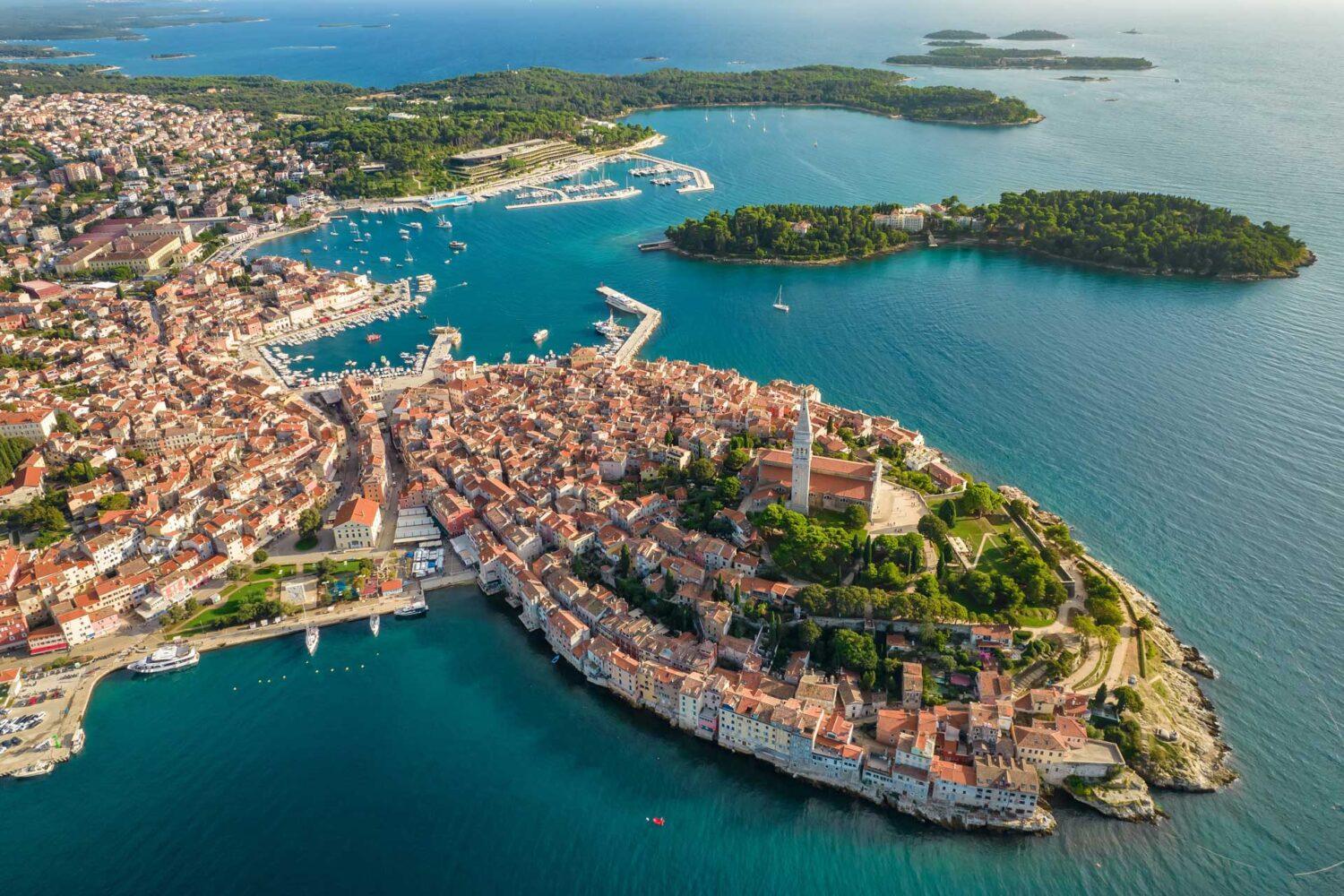
A peninsula in the northern Adriatic, home to quiet small Croatian towns that are popular with families and retirees relocating to the country. The region is known for its peaceful atmosphere and has a large immigrant population from Europe, particularly from Austria and Germany. Employment opportunities can be found in agriculture, winemaking, and tourism. Although there are no universities in Istria, Croatian language courses are available. The peninsula has a very high level of safety. The cost of living varies depending on the town but averages around EUR 800 per month, excluding rent.

Submit an application form and we'll get back to you!
Risks of Illegal Residence
Permanent residence in Croatia cannot be granted to an applicant who does not meet the basic legal requirements. At the time of submitting the application, the applicant must be residing in the Republic on the basis of a temporary residence permit or hold refugee status or subsidiary protection. Permanent residence will be refused if the grounds for remaining in the country are no longer valid. In the event of illegal stay, a foreign national may be deported from Croatia and may also be subject to an entry ban to Croatia and the European Union for a certain period.
Why Professional Assistance Is Important When Immigrating
When planning a move to Croatia, it is best to seek assistance from specialists in international immigration law. This recommendation can be found in many reviews from foreign nationals who attempted to complete the process on their own and encountered refusals. Professional lawyers can advise you on which immigration programs are worth considering and help you navigate every stage of the complex relocation process.
It should be noted that obtaining the right to reside in Croatia long-term does not necessarily require a residence permit, as citizens of European Union Member States may legally live in the country without one. Obtaining an EU passport is an alternative legal route for relocating to the Republic, allowing you to work, study, and conduct business without the need to obtain additional permits.
The company's specialists can help you obtain European Union citizenship through one of the simplified programs available in several EU countries. During a free consultation with one of our immigration lawyers, you will receive detailed information about the available immigration options. Our immigration specialists will also help you choose the optimal strategy for obtaining EU citizenship within as little as 12 months.
About the author

Diane Weber is an international law specialist with 10 years of legal practice experience. Her portfolio includes successful stories of citizenship in different European Union countries under simplified procedures. Diana provides detailed advice and helps many people to achieve their immigration goals in a short period of time, including resolving visa issues, assisting in obtaining residence permits and citizenship in the EU countries. In her blog, Diana Weber enjoys providing readers with detailed information about the features of most popular programs for obtaining a second passport.
No comments